
Last updated July 11, 2026
The Complete Guide to Garage Door in Atlanta
Most garage door guides are written for a hypothetical American homeowner. Here’s the problem: Atlanta sits on expansive red clay soil that swells when wet and shrinks during drought, creating seasonal foundation movement that directly stresses your garage door frame, tracks, and weather sealing. In our 17 years working across Fulton, DeKalb, and Cobb counties, we’ve seen alignment failures in Buckhead homes that have nothing to do with the door itself — and everything to do with soil mechanics that a Phoenix or Seattle technician wouldn’t recognize. This guide treats Atlanta as its own ecosystem. You’ll learn how our humid subtropical climate, HOA-dense neighborhoods, and clay-soil geology create specific failure patterns, which materials actually last here, and how to decide whether your situation calls for repair, replacement, or simple adjustment.
Quick Answer
Garage doors in Atlanta face unique stresses from expansive clay soil, high humidity, and temperature swings that accelerate spring corrosion and track misalignment. The right door for this market combines rust-resistant hardware, adequate insulation for humid summers, and panel styles that match neighborhood HOA standards. Most homeowners will face a repair-or-replace decision every 12–15 years, with annual maintenance extending that timeline significantly.
Table of Contents
- How Atlanta’s Clay Soil Affects Your Garage Door
- Climate-Smart Materials and Insulation for Atlanta
- The Brands and Styles You’ll Find in Atlanta Neighborhoods
- Navigating Atlanta’s HOA Requirements
- Repair vs. Replace vs. Adjust: An Atlanta Decision Tree
- Seasonal Maintenance That Actually Works Here
- When Atlanta Weather Creates Emergency Situations
- What Garage Door Work Costs in the Atlanta Market
How Atlanta’s Clay Soil Affects Your Garage Door
Atlanta’s foundation problems are legendary among contractors, and your garage door pays the price. The garage door repair in Atlanta calls we handle most often in late summer and mid-winter aren’t spring failures — they’re track misalignments caused by slab movement.
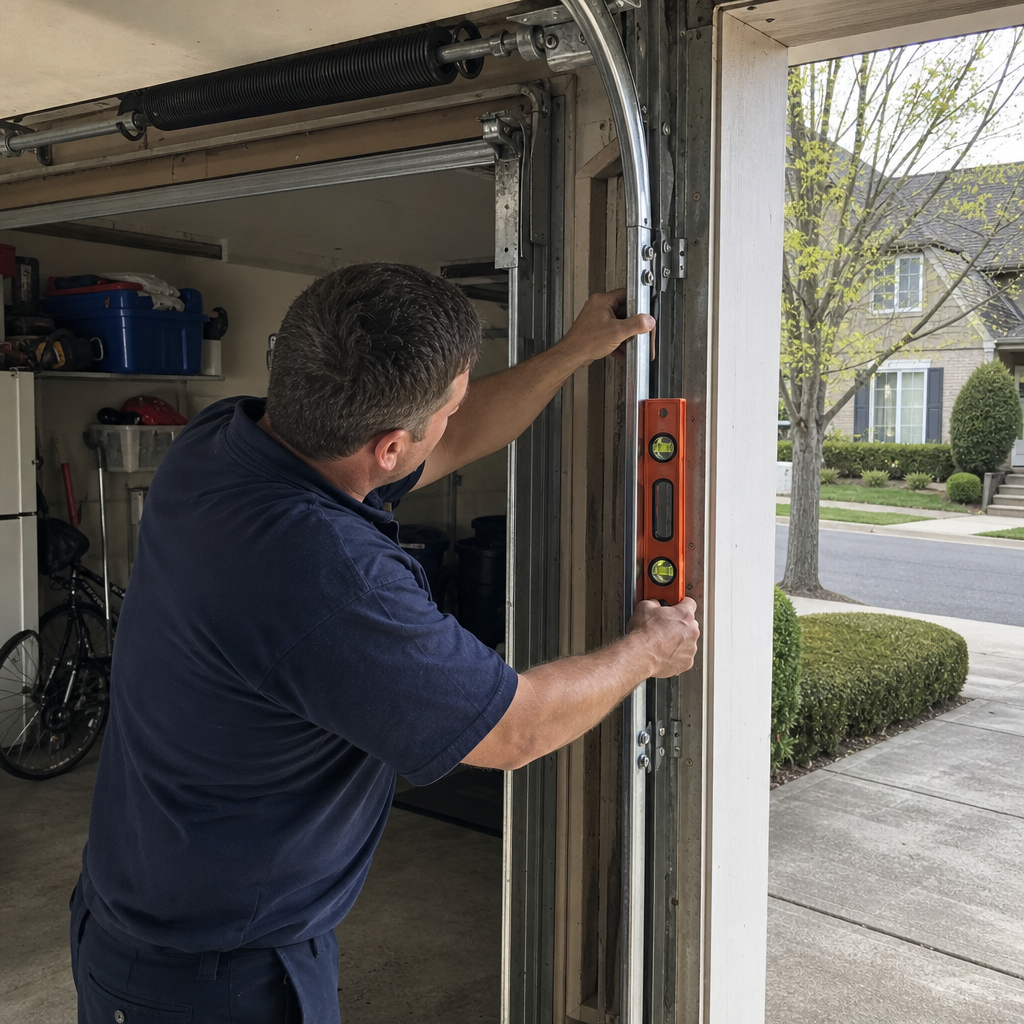
Here’s the mechanism: Georgia’s Piedmont clay expands up to 10% when saturated, then contracts during dry spells. This seasonal heave shifts garage slabs independently of house foundations. In Sandy Springs and Dunwoody, where lots slope toward street level, we’ve measured vertical slab displacement of ¾ inch between March and August on the same property. Your garage door frame is anchored to that moving slab. The tracks, which need parallel alignment within ¼ inch over the full door height, can’t tolerate that movement.
Specific symptoms of soil-related problems include:
- Rubbing or binding at the bottom corners — usually worse in late summer when soil is most expanded
- Inconsistent closing — the door seals properly on one side but gaps on the other
- Visible track divergence — the vertical tracks no longer appear perfectly parallel when viewed from inside the garage
- Recurring “fixed” problems — you’ve had alignment adjusted twice in two years
In Virginia-Highland and other intown neighborhoods with older construction, we’ve seen original 1920s garages where the concrete apron has settled so severely that standard track hardware can’t compensate. The solution isn’t always a new door — sometimes it’s a custom track configuration or frame reinforcement that accounts for permanent settlement.
For new installations, we recommend slightly oversized track brackets and flexible jamb seals that accommodate minor seasonal movement without binding. In our experience, spending an extra $80–$120 on hardware flexibility during installation prevents $200+ service calls later.
Climate-Smart Materials and Insulation for Atlanta
Atlanta’s climate rating is “humid subtropical,” which means 45+ inches of annual rainfall, summer humidity regularly above 80%, and winter lows that occasionally drop into single digits. This combination creates specific material stresses that northern or arid-climate guides don’t address.
Steel doors dominate the Atlanta market for good reason. They resist humidity-driven swelling better than wood, and modern galvanized coatings handle our rainfall patterns. However, not all steel is equal here:
| Specification | Atlanta Recommendation | Why It Matters |
|---|---|---|
| Steel gauge | 24–25 gauge minimum | Thinner steel dents from hail (common March–May) and flexes in heat |
| Galvanizing | G60 or G90 hot-dip | Electro-galvanized coatings fail faster in humid air |
| Insulation | R-6 to R-12 polystyrene or polyurethane | Prevents interior condensation that rusts hardware from inside |
| Exterior finish | Baked-on polyester or vinyl | Painted finishes chalk and fade within 3–4 years of Georgia sun |
Wood doors, popular in historic districts like Grant Park and Inman Park for aesthetic reasons, require more aggressive maintenance here than in drier climates. We’ve replaced Craftsman-style wood doors in Decatur that rotted at the bottom panel within seven years — not from ground contact, but from condensation cycling. If you choose wood, specify mahogany or cedar with marine-grade sealant, and budget for resealing every 18–24 months.
Insulation ratings matter more in Atlanta than simple R-value charts suggest. A non-insulated steel door in a west-facing Buckhead garage can reach 140°F surface temperature in July, transferring that heat to your garage interior and accelerating opener electronics failure. We typically specify R-8 minimum for attached garages, R-6 for detached structures with no HVAC connection.
The Brands and Styles You’ll Find in Atlanta Neighborhoods
Atlanta’s housing stock spans from 1910s Craftsman bungalows to 2020s build-to-rent townhomes, and garage door brand popularity tracks closely with construction era. Understanding what’s likely in your garage helps diagnose problems faster and source parts without delay.
1980s–1990s subdivisions (Gwinnett, Cobb, north Fulton): Wayne Dalton 9100 and 9600 series dominated builder specifications. These doors used proprietary TorqueMaster spring systems that are now obsolete. We’ve converted hundreds in Alpharetta and Roswell to standard torsion systems — the original springs fail predictably at 20–25 years, and Wayne Dalton no longer supports the hardware.
2000s–2010s production homes: Clopay Value Series and Amarr Stratford were standard builder grades. These use industry-standard hardware, which simplifies repair. However, the 25-gauge steel common to this era dents easily and provides minimal insulation.
Custom/renovation intown (2010s–present): We’re seeing more Raynor and custom Clopay Gallery Series installations in Virginia-Highland, Old Fourth Ward, and East Atlanta. These homeowners prioritize curb appeal and HOA compatibility over initial cost.
Openers by era: Pre-2010 homes frequently have original Craftsman chain-drive units (Sears was dominant in this market). Post-2010 builds standardized on LiftMaster belt-drive or Chamberlain WiFi-enabled models. We stock and service all eight major brands — garage door opener in Atlanta service requires brand familiarity because safety sensor configurations, travel limit adjustments, and force settings vary significantly.
Larry Peterson — Owner and Lead Technician — handles your job personally, bringing 17 years of hands-on experience with the brands already in your garage. When we arrive at a Johns Creek home with a 1998 Wayne Dalton and a failing Genie screw-drive opener, there’s no learning curve, no guesswork.
Navigating Atlanta’s HOA Requirements
Atlanta’s metro area has one of the nation’s highest concentrations of homeowners associations, and garage door visibility creates enforcement pressure that purely functional guides ignore. In our experience, HOA-related service calls fall into three categories:
- Color and finish restrictions: Many Alpharetta, Johns Creek, and Peachtree Corners HOAs specify white, almond, or sandstone only, with explicit prohibitions on “faux wood” finishes that read as brown. We’ve replaced doors that passed architectural review at installation but were later rejected when the HOA changed guidelines.
- Style mandates: Traditional neighborhood design (TND) developments like Serenbe and Vickery in Forsyth County require carriage-house panel designs or actual swing-out door configurations. Standard raised-panel steel doors are prohibited.
- Maintenance standards: Cracked panels, faded finishes, or visible rust spots trigger violation notices in communities with active enforcement. The citation typically allows 30 days for correction.
Before any replacement work in an HOA community, we verify the governing documents or, when possible, obtain written pre-approval. The cost of installing a non-compliant door and replacing it is substantial — we’ve seen $3,000+ mistakes in Sandy Springs and Dunwoody where homeowners acted without checking.
Some Atlanta HOAs also regulate opener noise. Belt-drive and direct-drive openers are increasingly specified over chain-drive in townhome communities where bedrooms share walls with garages. We carry LiftMaster and Chamberlain quiet-operation models specifically for these situations.
Repair vs. Replace vs. Adjust: An Atlanta Decision Tree
This is where most homeowners stall. Use this framework based on what we’ve observed across 296 completed jobs in the Atlanta market:
Repair is the right choice when:
- Single panel damage from isolated impact (backing into door, storm debris)
- Spring failure on a door less than 12 years old with otherwise sound hardware
- Opener malfunction with door that operates smoothly by manual release
- Track misalignment following minor slab settlement (adjustable within hardware range)
Replace is justified when:
- Multiple panel failures or structural rust (especially bottom section)
- Insulation value below current standards and garage is conditioned space or workshop
- Obsolete parts (Wayne Dalton TorqueMaster, certain Raynor torsion systems pre-2005)
- Slab settlement exceeds 1 inch — new door on adjusted frame often outlasts repeated repairs
- Energy costs justify upgrade (west-facing, uninsulated door in sun-exposed garage)
Adjust only — no parts needed — when:
- Seasonal binding that resolves with track realignment and lubrication
- Opener force settings drifted out of spec (common after power outages)
- Weather seal compression from normal aging (not tearing or cracking)
In our experience, Atlanta’s soil movement means “adjust only” cases require more frequent revisit than national averages. We recommend annual inspection for homes in high-expansion clay zones — particularly Brookhaven, Chamblee, and areas east of I-85 where the Danforth formation creates extreme swell potential.
Garage door installation in Atlanta requires particular attention to slab condition and drainage. We won’t install a premium door on a slab with active settlement without documenting the condition — it’s unfair to the homeowner and damages our reputation.
Seasonal Maintenance That Actually Works Here
Generic maintenance schedules assume stable foundations and moderate humidity. Atlanta needs a location-specific approach.
March–April (post-winter, pre-storm):
- Inspect weather seal for rodent damage — spring breeding season drives mice into garages, and they chew vinyl seals
- Check track alignment after winter soil contraction; adjust if binding appeared during cold snaps
- Lubricate rollers and hinges with silicone-based lubricant (not WD-40, which attracts Piedmont clay dust)
- Test force settings and auto-reverse — ice accumulation may have masked calibration drift
July–August (peak humidity, peak soil expansion):
- Inspect bottom panel and hardware for corrosion — condensation is highest when hot exterior meets air-conditioned interior
- Clear drainage channels around slab perimeter; standing water accelerates clay expansion
- Check opener motor housing for moisture intrusion; we replace 8–10 moisture-damaged logic boards annually in Atlanta
- Verify safety sensor alignment — humidity can corrode wire connections, causing intermittent failure
October–November (soil contraction begins):
- Re-tighten track mounting hardware that loosened during summer expansion
- Inspect spring coils for surface rust — our humid fall accelerates corrosion before winter temperature swings stress the metal
- Apply fresh silicone to seal contact surfaces
Annual professional inspection catches what DIY maintenance misses. We charge for this service, but it typically pays for itself in extended component life and avoided emergency calls.
When Atlanta Weather Creates Emergency Situations
Our Sequoia Garage Door Repair Georgia home page lists emergency garage door service because specific Atlanta weather events create genuinely urgent situations.
Summer severe storms (March–September): Lightning strikes destroy opener logic boards. Falling limbs dent doors off-track. We’ve responded at 10 PM to homes in Decatur where a storm-damaged door couldn’t secure the garage overnight.
Winter freeze events: January 2014 and January 2022 brought single-digit temperatures that froze weather seals to concrete, tearing them when doors opened. Frozen condensation in torsion tubes caused binding that burned out opener motors.
Prolonged drought followed by heavy rain: The rapid soil expansion after 2016–2017 drought conditions created our busiest six-month period for track realignment calls, particularly in areas with mature trees that had desiccated root zones.
Emergency service means we show up — not that we answer the phone and schedule for Tuesday. When your garage door won’t move, we arrive with the parts to fix it, not to diagnose and order.
What Garage Door Work Costs in the Atlanta Market
Pricing transparency matters. These ranges reflect our actual 2023–2024 Atlanta-area invoices, adjusted for current material costs:
| Service | Typical Range | Factors Affecting Price |
|---|---|---|
| Spring replacement (standard torsion) | $180–$340 | Door weight, spring cycle rating, single vs. double spring |
| Spring replacement (Wayne Dalton TorqueMaster conversion) | $320–$480 | Includes hardware kit to convert to standard system |
| Opener repair (minor) | $120–$220 | Sensor realignment, limit switch, circuit board |
| Opener replacement | $450–$850 | Chain vs. belt vs. wall-mount; WiFi capability; horsepower |
| Track realignment | $140–$280 | Simple adjustment vs. bracket replacement vs. custom bending |
| Panel replacement (steel, standard size) | $280–$550 | Brand availability, color match, insulation matching |
| Full door replacement (standard steel, installed) | $1,100–$2,400 | Size, gauge, insulation, window options, hardware grade |
| Full door replacement (carriage house/custom) | $2,800–$5,500 | Material, design complexity, HOA-mandated specifications |
These ranges assume standard 8×7 or 16×7 residential doors. Oversized or custom dimensions increase costs proportionally. We provide written estimates before beginning work — no surprises.
Atlanta’s cost of living and contractor licensing requirements place us slightly below national averages for major metro areas but above rural Georgia pricing. The premium over small-town rates reflects proper insurance, vehicle fleet maintenance for metro traffic, and the expertise to handle Atlanta-specific problems correctly the first time.
Common Mistakes to Avoid
- Ignoring seasonal binding as “normal.” Track resistance that changes with weather is early warning of soil movement, not character. Addressing it promptly prevents opener strain and premature failure.
- Choosing wood doors for historic aesthetics without maintenance commitment. We’ve replaced seven-year-old wood doors in Grant Park that could have lasted 20+ with proper sealing schedules.
- DIY spring replacement. Torsion springs store lethal energy. We won’t detail the procedure because the injury risk is unacceptable — we’ve treated enough homeowners who attempted this.
- Matching replacement panels by visual similarity only. Gauge, insulation, and backing structure must match for proper door balance. Mismatched panels stress openers and create uneven wear.
- Neglecting drainage around slab perimeter. Atlanta’s clay soil expands most dramatically where water pools. A $200 gutter extension prevents $800+ in repeated alignment work.
- Assuming all openers are interchangeable. Ceiling height, door weight, and headroom dimensions constrain opener selection. We’ve removed incorrectly specified jackshaft openers that couldn’t handle solid wood doors.
- Skipping pre-installation HOA verification. The $50 architectural review fee prevents $3,000+ non-compliance replacement.
When to Call a Professional
Call when the door won’t operate smoothly by manual release, when springs show visible damage or separation, when tracks appear bent or severely misaligned, or when opener behavior changes suddenly after weather events. These symptoms indicate conditions beyond adjustment — continued operation risks component cascade failure.
We’re particularly concerned about doors that reverse unexpectedly or fail to reverse when obstructed. Federal safety standards require auto-reverse function; failure creates liability and genuine injury risk, especially with children present.
Sequoia Garage Door Repair Georgia offers free estimates in Atlanta — call (844) 950-3304. Larry Peterson evaluates your situation personally, explains whether repair, replacement, or adjustment serves your interests, and provides written pricing before any work begins.
Frequently Asked Questions
Standard torsion spring replacement in Atlanta typically runs $180–$340, with Wayne Dalton TorqueMaster conversions at $320–$480 due to additional hardware. Single-car doors with lighter springs fall at the lower end; double-width or solid wood doors requiring heavier springs cost more. Call (844) 950-3304 for an exact quote — estimates are free.
We maintain stock of common springs, rollers, cables, and opener components for the brands most prevalent in Atlanta homes. Same-day service is frequently available for standard repairs, though complex situations requiring custom panels or specialized hardware may need 24–48 hours. Emergency garage door service is available for situations where security or safety is compromised.
Repair is more economical when damage is isolated and the door is under 12 years old with sound structure. Replacement becomes cost-effective when multiple panels fail, parts are obsolete, insulation is inadequate, or slab settlement makes reliable alignment impossible. We provide both repair and replacement estimates when the decision is unclear.
Atlanta’s 80%+ summer humidity accelerates spring corrosion, swells wooden components, and creates condensation on steel surfaces that promotes rust from the inside out. Proper galvanizing, regular silicone lubrication, and adequate ventilation extend typical lifespan from 10–12 years to 15–20 years.
1980s–1990s homes frequently have Wayne Dalton with TorqueMaster springs. 2000s–2010s production homes standardized on Clopay and Amarr. Recent custom builds favor Raynor and Clopay Gallery Series. Openers are predominantly LiftMaster, Chamberlain, and legacy Craftsman units. We stock and service all eight major brands — no learning curve, no guesswork.
Most Atlanta-area HOAs require pre-approval for exterior changes, including garage door replacement. Color, style, and sometimes noise specifications are enforced. We recommend obtaining written approval before ordering; we can provide specification sheets for any door we quote to streamline your application.
The Bottom Line
Atlanta’s garage doors fail in predictable patterns that national guides miss: clay soil movement, humidity-driven corrosion, and HOA constraints create a unique service environment. The right decisions — appropriate materials, seasonal maintenance, soil-aware installation, and professional repair when safety components are involved — extend door life and prevent emergency situations. Whether you’re maintaining a 1995 Wayne Dalton in Roswell or selecting a carriage-house upgrade for a Virginia-Highland renovation, local expertise matters. Generic advice wastes money; Atlanta-specific assessment protects it.
Ready to discuss your garage door? Call Sequoia Garage Door Repair Georgia at (844) 950-3304 for a free estimate. Larry Peterson — Owner and Lead Technician — handles your job personally, bringing 17 years of hands-on experience with the brands already in your garage.
Written by Larry Peterson, Owner & Lead Technician at Sequoia Garage Door Repair Georgia, serving Atlanta since 2009.