
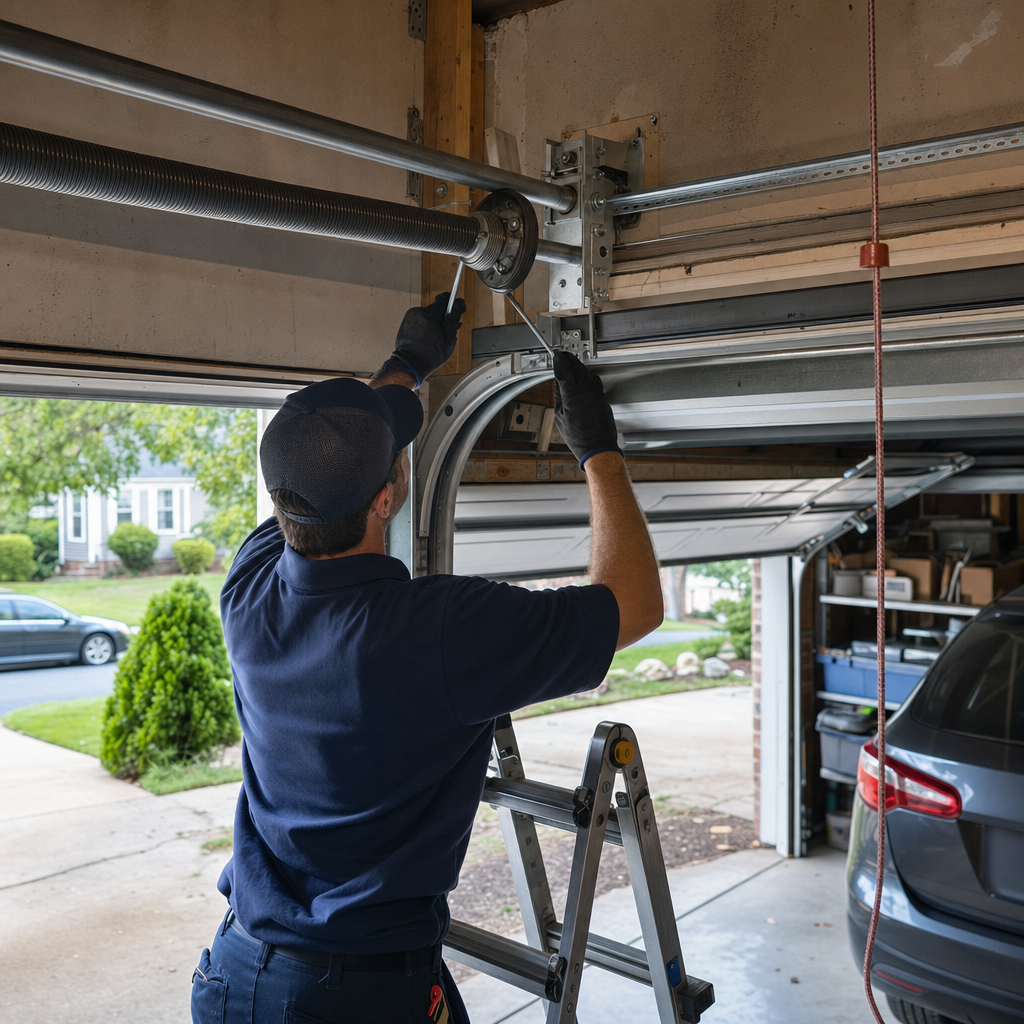
Garage Door Cable Replacement in Georgia: Same-Day Repair from $130–$250
A snapped garage door cable in Georgia typically runs $130–$250 to replace, and most jobs can be completed same-day when you call (844) 950-3304. The cable itself is only part of the story — what actually failed started weeks earlier, usually as visible fraying where the cable wraps around the drum, accelerated by our state’s punishing humidity. At Sequoia Garage Door Repair Georgia, we replace cables in pairs, inspect spring tension every time, and show you exactly what went wrong before we fix it.
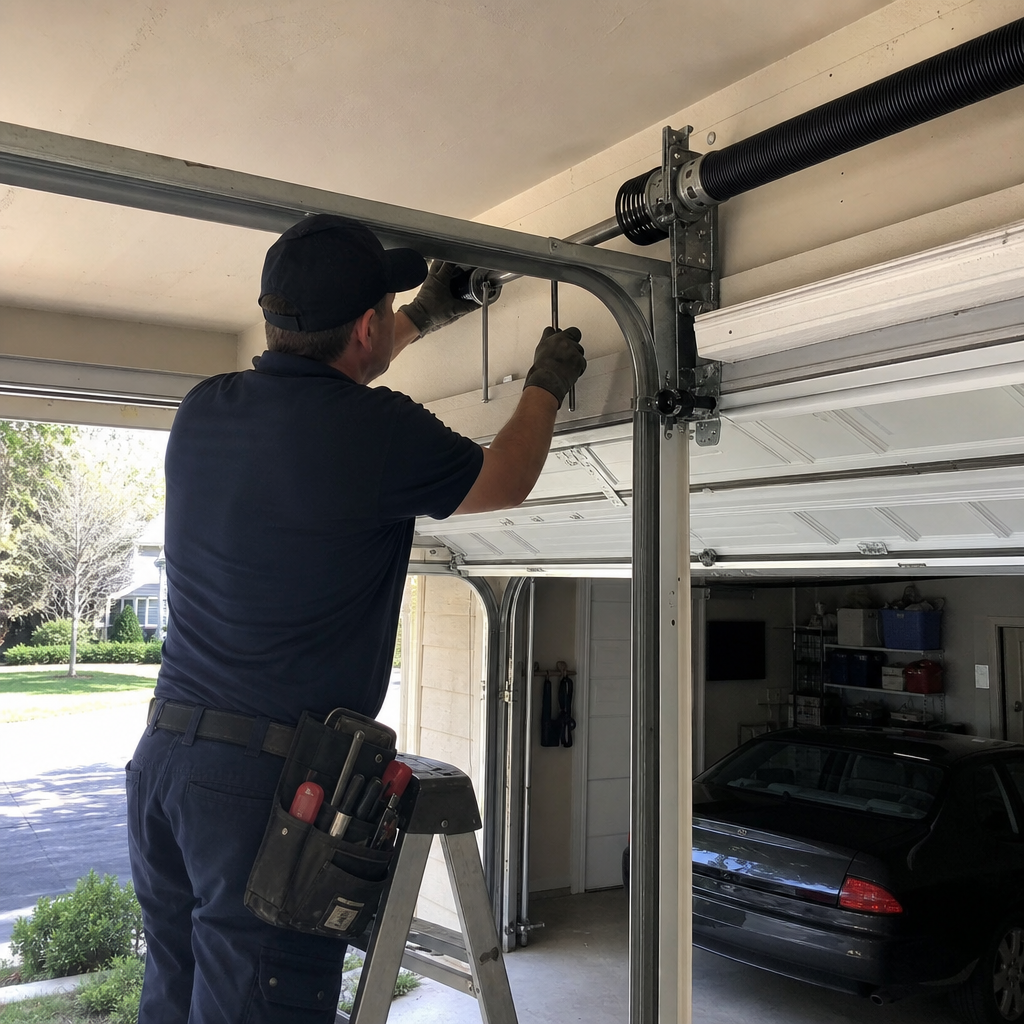
Why Cables Snap in Georgia — And Why It’s Rarely “Sudden”
A garage door cable looks like it failed without warning. In 17 years on job sites across Georgia, Larry Peterson has found that almost every snapped cable told the truth beforehand — if someone had been looking at the right spot.
Here’s what actually happens: galvanized steel cables fray at the drum contact point first. That drum is the pulley wheel at the top of your door where the cable wraps and unwraps with every open and close. The constant bending creates microscopic fatigue. Add Georgia’s humidity — especially the heavy, wet air that rolls through from late spring through October — and that fatigue accelerates into corrosion. The cable doesn’t look dramatically damaged from the ground. Shine a flashlight on the drum wrap zone, though, and you’ll often see rust-colored dusting, individual strands poking outward, or a fuzzy “bird’s nest” texture that precedes a clean break by days or weeks.
We’ve replaced cables in Decatur ranch homes where the drum corrosion was so advanced the cable crumbled like a wet paper towel. We’ve seen Stone Mountain townhouses with cables that looked fine from below but had lost 40% of their cross-section where they wrapped the drum. The pattern is consistent enough that Larry checks this exact spot first on every service call — it’s become a reflex after nearly two decades.
What you can check safely: With the door closed and the opener disconnected, shine a flashlight on the cable where it meets the drum. Look for rust dust, stray strands, or any flattening where the cable wraps. Do not touch or manipulate the cable — if the door is under spring tension, this is dangerous work for a trained technician.
Lift Cables vs. Safety Cables — Most Pages Get This Wrong
Generic “garage door cable” articles conflate two completely different parts. We’ve fixed both, and they fail for different reasons, require different parts, and carry different risks.
Lift cables do the heavy work. They’re the thick braided cables on each side of your door that attach to the bottom bracket and wind around the torsion or extension spring system. When a lift cable snaps, the door goes crooked, jams in the track, or crashes down unevenly. These are what most homeowners mean when they say “my cable broke.”
Safety cables thread through extension springs on older or lighter door setups — common in pre-1990s Georgia subdivisions and some budget new construction. Their job isn’t to lift; it’s to catch a flying spring if the extension spring breaks under tension. A failed safety cable means a broken spring becomes a projectile hazard. We’ve found safety cables rusted clean through in East Point basements where nobody had looked in a decade.
Larry carries both cable types and the best garage door parts in Georgia, GA on his truck, sized for doors from 7-foot residential to 8-foot oversized singles common in newer Georgia builds. We don’t guess which you have — we identify it, explain the difference on-site, and show you the wear pattern that caused the failure.
Why We Always Replace Cables as a Matched Pair
A homeowner calls with one broken cable and wants to save money replacing just that side. We understand the impulse. Here’s why we won’t do it — and why any technician who agrees to a single-side replacement is either inexperienced or prioritizing the quick sale over your next service call.
Garage door cables are installed at the same time, exposed to identical cycles, humidity, and drum wear. The broken cable didn’t age alone; its partner on the opposite side is within days or weeks of identical failure. Replace one, and you’re scheduling another visit — often at the most inconvenient possible moment, because the surviving cable is now carrying uneven load and fatiguing faster.
Our standard practice: replace both lift cables, re-tension the spring system to factory spec, and lubricate the drums and bearings. The incremental part cost is minor compared to a second truck roll. More importantly, the paired replacement lets us verify that your spring system is balanced — because an unbalanced spring is what often causes premature cable failure in the first place.
This is where owner-operator accountability matters. A dispatched subcontractor working on volume incentive has every reason to swap the broken cable, collect payment, and move to the next job. Larry Peterson — Owner and Lead Technician — is the one who answers your call, drives the truck, and stands behind the work. If a cable we replace fails prematurely, we’re the ones who come back. That changes how you diagnose and how you quote.
The Cable-Spring Connection: Why We Inspect Tension Every Time
A cable doesn’t fail in isolation. The spring system determines how much load the cable carries, how evenly it’s distributed, and how abruptly that load shifts when the door hits a sticking point in the track.
When a torsion spring is out of balance — one side tighter than the other — the cable on the looser side takes disproportionate wear. The drum wraps unevenly. The cable snakes instead of laying in clean coils. We’ve seen this in Tucker homes where a previous “technician” adjusted spring tension by guesswork, leaving the door 15 pounds heavier on one side. The cable lasted eight months.
Larry inspects spring tension and door balance on every cable replacement. Not as an upsell — as a diagnostic step that explains why the cable failed and prevents the next failure. If your spring is nearing end of life, we’ll show you the wear indicators and quote honestly: cable replacement now, spring replacement recommended in one season or three, based on what we see. No surprises. No “while we’re here” pressure.
Our factory familiarity with Clopay and Amarr door systems — the two brands we see most often in Georgia residential construction — means we know the specified cable gauge, drum diameter, and spring IPPT (inch-pounds per turn) for your exact setup, whether you need standard hardware or garage door parts near me in Georgia, GA. No guesswork. No “universal” parts that sort of fit.
Georgia’s Humidity: A Specific Corrosion Pattern You Can Spot
We’ve mentioned the drum contact point, but Georgia’s climate creates a broader corrosion signature worth understanding. Our state’s humidity doesn’t just rust cables — it creates a particular failure mode that technicians from drier climates often miss.
The pattern: cables corrode from the inside out where moisture wicks into the braided core and sits, especially in unconditioned garages common in Avondale Estates and older Decatur neighborhoods. The outer strands look acceptable while the core has turned to rust powder. A cable in this condition can pass a casual visual inspection and still snap under the shock load of a cold morning start.
Larry tests for this with a simple, non-destructive check: gentle flexion of the cable near the bottom bracket while watching for rust dust ejection from the braid. It’s a quick tell that separates surface oxidation from structural corrosion. Combined with drum-wrap inspection, it catches cables that would otherwise fail within the season.
For homeowners in Georgia’s lowest-lying areas — where garage humidity runs highest — we also recommend periodic lubrication with a moisture-displacing garage door lubricant (not WD-40, which attracts dust) and checking whether garage door roller replacement in Georgia, GA is needed. This is practical maintenance you can do, between professional tune-ups, to extend cable life.
Common Local Scenarios We Handle
These are the cable calls we actually run in Georgia — not generic hypotheticals, but the patterns that repeat across neighborhoods we serve.
- The 7 AM commute trap: Cable snaps overnight or at first open attempt. Car is stuck inside, spouse needs to get to work, kids need school drop-off. Larry’s emergency garage door service means we’re often on-site within the hour — not because we market “24/7” but because the owner-operator takes the call personally and routes himself.
- The DIY adjustment gone wrong: Homeowner notices slack cable, tries to “tighten” it by adjusting the drum set screws without releasing spring tension. Now the cable is off the drum, the door is crooked, and the spring is dangerously overwound. We see this monthly. Please — call before adjusting anything under tension.
- The extension spring safety cable failure: Older Georgia homes with original hardware. Safety cable rusts through, extension spring breaks, and the spring launches across the garage. The safety cable’s one job was to prevent exactly this. We replace with coated cables rated for modern cycle life.
- The “it was fine last season” surprise: Door worked perfectly in fall, first cold snap in Georgia winter and the cable snaps. Thermal contraction on already-fatigued metal is the final straw. The damage accumulated silently through humid summer months.
- The mismatched replacement: Previous technician used a 7×19 aircraft cable where the manufacturer specified 7×7 galvanized, or wrong drum diameter for the door height. Door works poorly, cables wear prematurely, and the homeowner thinks the brand is at fault. We source correct Garage Door Parts to factory spec.
What Cable Replacement Costs in Georgia
Our pricing is straightforward and consistent with market rates across the greater Georgia area. The table below covers cable work specifically; for related services, we maintain transparent ranges so you can plan.
| Service | Price Range |
|---|---|
| Cable Repair / Replacement (pair) | $130 – $250 |
| Spring Repair | $180 – $340 |
| Track Realignment | $120 – $240 |
| Roller Replacement | $110 – $220 |
| Opener Repair | $120 – $320 |
| Opener Installation | $250 – $550 |
| Panel Replacement | $250 – $500 |
| New Door Installation | $700 – $2,200 |
| General Garage Door Repair | $150 – $600 |
Cable replacement pricing varies with door height (7-foot vs. 8-foot cables are different parts), single vs. double-wide, and whether spring rebalancing is needed. We quote exact before starting work — no open-ended hourly rates, no “plus parts” surprises.
Key Takeaways
- Garage door cable replacement in Georgia runs $130–$250 for a properly done paired replacement
- Visible fraying at the drum contact point precedes nearly every snap — inspect with a flashlight, but don’t touch
- Georgia’s humidity corrodes cables from the inside out; surface appearance can deceive
- Always replace cables in pairs; single-side replacement guarantees a second failure
- Spring balance inspection is mandatory — unbalanced springs destroy cables prematurely
- Larry Peterson, Owner and Lead Technician, handles every call personally — no subcontractor roulette
FAQs
Cable replacement typically costs $130–$250 in the Georgia area, with most residential jobs falling in the middle of that range. The exact price depends on your door height, whether we need to rebalance springs, and if we’re replacing standard lift cables or extension spring safety cables. Call (844) 950-3304 for a free, exact quote — no obligation, no pressure.
Yes — we prioritize cable failures because a non-functional door traps vehicles and creates security exposure. As an owner-operator, Larry Peterson routes himself directly to urgent calls, and our emergency garage door service means we’re genuinely available beyond standard hours, not just marketing it. Same-day repair is standard for Georgia-area calls received before early afternoon.
Cables are a replacement-only component — once frayed or snapped, they cannot be safely repaired. The real cost decision is whether to replace one cable or both. We replace in pairs because the unbroken cable is equally aged and guaranteed to fail soon after. The small additional part cost prevents a second service call and protects your door from uneven wear. We’ll show you both cables and explain the condition before we start.
Most cable failures in Georgia trace to three causes: corrosion from humidity (especially at the drum contact point), normal cycle fatigue after 8–12 years of use, or an underlying spring imbalance that overloaded one side. A snapped cable is almost always a symptom, not an isolated problem — which is why we inspect spring tension and door balance on every cable job. Call (844) 950-3304 and we’ll diagnose the root cause, not just swap the part.
When Your Cable Goes, We’re the Call That Gets It Right
A garage door either works right or it doesn’t — let’s make sure yours does. Whether you’re looking at a frayed cable you just spotted, dealing with a complete snap that’s trapped your car, or trying to understand why this keeps happening, we’ll give you straight answers and fix it the right way. No subcontractor sent from a call center. No parts that “should work.” Just Larry Peterson, 17 years of hands-on experience, and the accountability that comes from putting your name on every job.
Call (844) 950-3304 now for a free estimate. We’ll answer your questions, explain what we’re seeing, and get your door moving safely again.
Written by Larry Peterson, Owner & Lead Technician at Sequoia Garage Door Repair Georgia, serving Georgia, GA.