
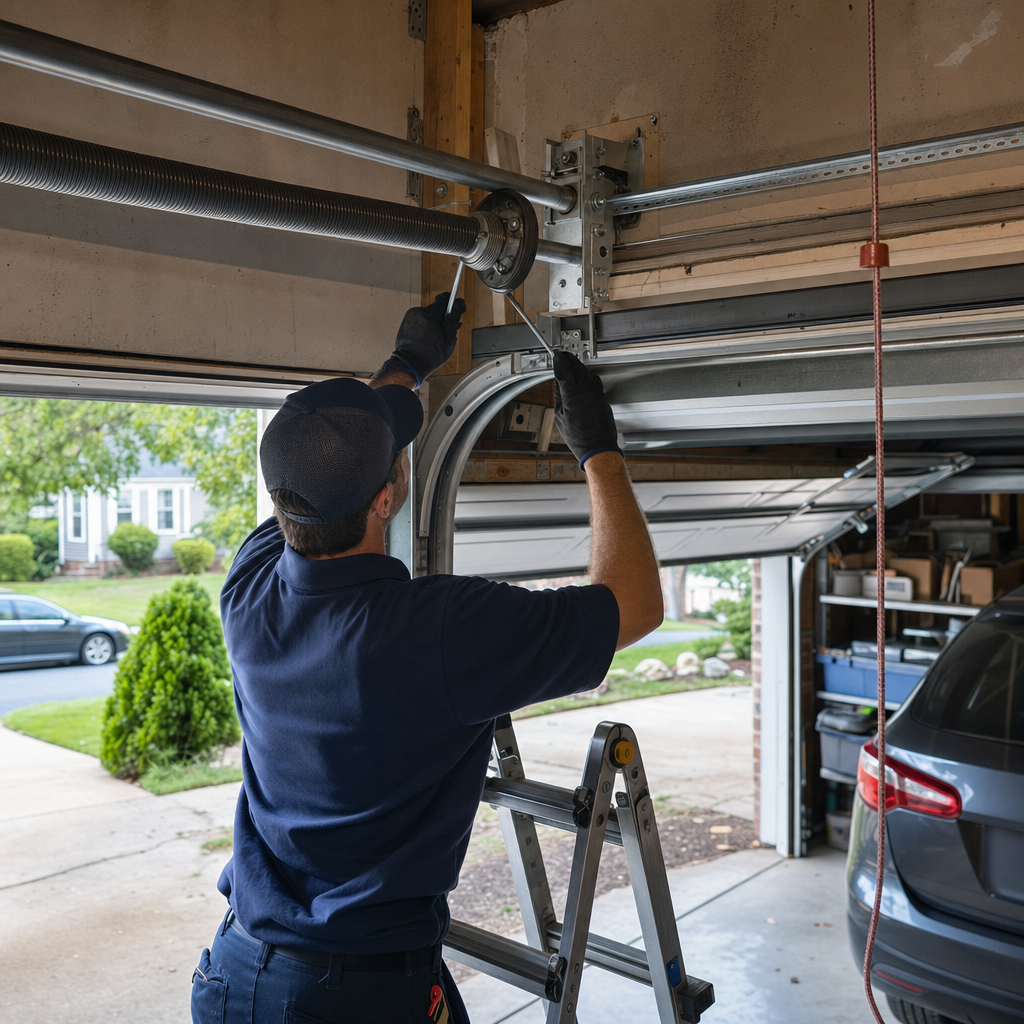
New Garage Door Installation Cost in Georgia: $700–$2,200 — But the Exact Number Depends on What’s Behind Your Brick
Our Best Garage Door Installation in Georgia, GA service typically runs $700–$2,200 depending on door material, insulation rating, hardware grade, and the condition of your existing frame. Most Georgia homeowners land in the $1,100–$1,600 range for a quality insulated steel door with standard hardware and professional installation. Call (844) 950-3304 for a free, exact quote measured to your opening — we don’t guess over the phone.
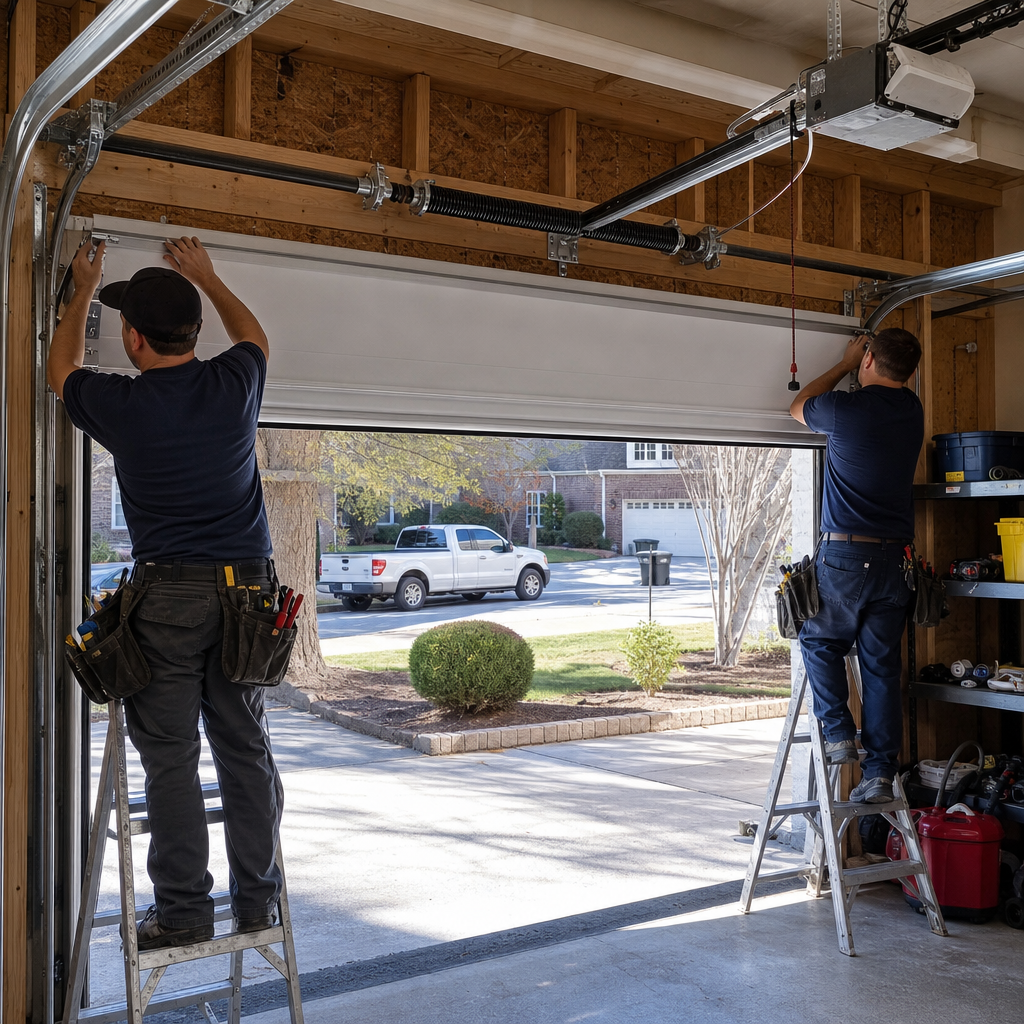
Here’s something we’ve learned after 17 years on job sites across Georgia: a $900 estimate and a $2,400 estimate can both be honest numbers. The difference isn’t markup — it’s whether someone measured your actual rough opening, checked if your brick facade limits trim options, and calculated the R-value that makes sense for a Georgia climate that hits 95°F in August and occasionally ices over in January. We’ve seen too many homeowners in neighborhoods like Decatur, Stone Mountain, and Sandy Springs get burned by flat-rate quotes that balloon once the installer realizes the standard trim kit won’t work with their brick surround, or that the “insulated” door they ordered has an R-value so low it might as well be a screen door for thermal transfer.
Larry Peterson — our Owner and Lead Technician — handles every installation personally. He grew up in Decatur, trained in mechanical systems at Georgia Piedmont Technical College, and has spent nearly two decades diagnosing what Georgia homes actually need before the door ever gets ordered. That upfront diligence is why our 296 verified reviews average 4.8 stars: we quote what the job needs, not what sounds good on a sales call.
Why Georgia’s Housing Stock Changes the Math
Georgia’s residential architecture — especially the brick-front ranches, split-levels, and newer subdivisions from Alpharetta to McDonough — creates installation variables that national cost calculators never catch.
Brick exteriors dominate here. Unlike vinyl or wood siding, brick limits how much you can modify the exterior frame without masonry work. Standard garage door trim packages assume a wood or vinyl surround with flexibility for adjustment. When your opening is bordered by brick, the jamb must fit precisely within existing mortar lines, or you’re looking at tuckpointing or brick cutting — neither of which is in the base door price.
We’ve walked into jobs in Lawrenceville where a homeowner bought a “standard” door online, only to discover the included trim couldn’t bridge the gap between the jamb and the brick face. The fix: custom-built exterior trim or reframing, adding $200–$500 to what seemed like a bargain. Larry spots this during his initial measurement — not when the delivery truck shows up.
Georgia’s clay-heavy soil also matters. In areas like Conyers and parts of Gwinnett County, seasonal expansion and contraction shift foundations slightly. That movement transfers to garage door frames. A door installed without checking plumb and level against a potentially shifted opening will bind, gap, or wear hardware prematurely. We budget 15–20 minutes of frame adjustment into every Georgia install; some competitors rush past this and leave you with a door that “works” but grinds itself to death in two years.
Breaking Down What You Actually Pay For
If you’re wondering How Much Does Garage Door Installation Cost? (2026 Price Guide) — Georgia, GA, here’s the itemized reality for Georgia homeowners:
| Component | Typical Range | What Drives the Variance |
|---|---|---|
| Steel door (non-insulated) | $400–$700 | Gauge thickness (24–27 ga), panel style, window inserts |
| Steel door (insulated, R-6 to R-9) | $650–$1,100 | Polyurethane vs. polystyrene core, panel design |
| Steel door (high-insulation, R-12 to R-17) | $900–$1,600 | Thicker core, thermal break, premium hardware prep |
| Aluminum full-view or custom | $1,200–$2,500+ | Glass type, frame finish, custom sizing |
| Wood composite or carriage house | $1,500–$3,500+ | Material grade, overlay detail, stain/finish |
| Standard hardware kit (springs, track, rollers, hinges) | $150–$350 | Cycle rating on springs, track gauge, roller material |
| Opener (if new or replacement) | $250–$550 installed | Chain vs. belt drive, horsepower, smart features |
| Installation labor | $300–$600 | Opening condition, disposal needs, frame repairs |
| Old door removal & haul-away | $75–$150 | Weight, disposal fees, whether opener stays |
| Brick-specific trim/masonry adaptation | $0–$400 | Only if needed — we flag this during measurement |
Our Garage Door Installation page covers full service details, but the table above is what most cost-searchers actually need. Total installed price for a typical Georgia home: $700 at the low end (basic non-insulated steel, clean opening, existing hardware reused) to $2,200 for most premium residential setups (high-R insulated door, new hardware, opener, disposal, and brick trim adaptation).
We itemize every line before you commit. No “it’ll be around this much” that drifts upward. Larry writes the quote, does the work, and answers for the number.
R-Value Reality: What Insulation Actually Means in Georgia
Most pages say “insulated doors cost more” and stop. Here’s what that means for your specific situation in Georgia.
Georgia straddles climate zones 3 and 4. Atlanta and north Georgia see more winter demand; south Georgia leans zone 3 with longer cooling seasons. This matters because R-value recommendations from national sources often assume a northern heating-dominant climate or a southern cooling-only one. Georgia does both.
Attached garages with living space above or adjacent: R-12 to R-16 is worth the upgrade. We’ve measured thermal transfer through uninsulated or low-R doors in homes near Emory and Virginia-Highland where the bedroom above the garage ran 8–12°F warmer in July and colder in January. A properly insulated door with thermal break reduces that load meaningfully. The payback isn’t instant, but the comfort difference is immediate, and HVAC runtime drops measurably.
Detached utility garages or workshops: R-6 to R-9 is usually sufficient. If you’re not conditioning the space or it’s separate from living areas, the premium for high-R rarely justifies itself. We tell homeowners in rural Georgia properties this directly — no upsell.
Non-insulated doors: Still available, still legal, still functional. We install them for budget-focused rental properties and some detached structures. But we won’t pretend they’re equivalent for attached residential use. The price gap between non-insulated and entry-level insulated has narrowed to $150–$300 on most sizes; for most Georgia homeowners, that’s worth crossing.
One detail competitors miss: R-value testing methods vary. Some manufacturers quote “center of panel” R-value, which ignores the edges and hardware penetrations where actual heat loss concentrates. We spec doors with whole-door R-values or at least factor in that real-world performance runs 10–20% below the sticker number. Larry’s been burned by this once — early in his career — and now he verifies manufacturer claims against actual installed performance.
Brand-Specific Installation: Why Factory Familiarity Saves Money
We stock and service eight major brands — LiftMaster, Chamberlain, Genie, Clopay, Amarr, Wayne Dalton, Craftsman, and Raynor — and that familiarity matters to your final cost.
Each manufacturer ships doors with different spring tension pre-sets, track gauge standards, and hardware torque specifications. A Clopay Gallery Collection door uses a different spring winding calculation than a Wayne Dalton TorqueMaster system. Raynor’s BuildMark series has specific header requirements that differ from Amarr’s Stratford line. When an installer encounters these for the first time on your job, two things happen: the install takes longer (you pay more labor), and the risk of misconfiguration rises (you pay for callbacks).
Larry doesn’t subcontract installs to technicians reading instructions in your driveway. He’s configured thousands of these specific systems. That efficiency translates to accurate quotes — we know how long each brand’s typical install runs, what hardware quirks to anticipate, and whether your existing opener will need reprogramming or replacement to pair with the new door.
For LiftMaster and Chamberlain opener integrations specifically, we pre-check compatibility with your chosen door’s weight and cycle rating. A mismatched opener — say, a 1/2-horsepower unit on a heavily insulated 16-foot door — burns out prematurely and costs you a replacement in 2–3 years. We catch that during quoting, not after the warranty expires.
The Disposal Question Homeowners Forget to Ask
Old door removal and haul-away is either included or itemized explicitly in our quotes — never a surprise add-on at completion. Here’s why this matters:
- A standard 16×7 steel door weighs 150–200 pounds. Wood or overlay doors can hit 300+.
- Georgia disposal regulations vary by county. Some landfills accept garage doors as construction debris; others require metal separation or charge by weight.
- DIY disposal means truck rental, loading, landfill fees, and your Saturday. We’ve had homeowners in Johns Creek and Roswell tell us this alone justified professional installation.
- We haul away and properly dispose of old doors on every install job. The cost is built into your quote upfront — typically $75–$150 depending on door weight and distance to appropriate disposal.
If you’re keeping your existing opener, we inspect it during removal and flag any wear that would compromise the new door’s performance. Sometimes the opener is fine; sometimes the rail is bent, the trolley worn, or the force settings misconfigured for the old door’s weight. Again — spotted before install, not after.
What Can Push Your Install Above $2,200
Most Georgia residential installs fall within our standard range, but certain conditions extend the scope:
Structural frame replacement: Rot, termite damage, or previous DIY modifications that compromised the header or jambs. We’ve found this in older Decatur bungalows and some 1980s-era subdivisions where original builders used undersized headers. Frame rebuild adds $400–$800.
Oversized or custom openings: RV-height doors, extra-wide two-car openings, or non-standard widths common in custom homes around Alpharetta or Milton. Custom door manufacturing runs $1,500–$3,500+ before installation.
Electrical work for opener location: If you’re relocating an opener or adding one where no outlet exists, licensed electrical work is required. We coordinate this but don’t perform it ourselves — we refer to licensed electricians we trust, and we flag the need during quoting.
High-wind load requirements: Some Georgia counties near the coast have wind-load codes for garage doors. This applies to fewer homeowners, but when it does, reinforced doors and hardware add $300–$600.
We disclose these possibilities during measurement, not during installation. That’s the difference between an estimate and a quote — and we deliver quotes.
FAQs
Most homeowners in Georgia pay between $1,100 and $1,600 for a complete new garage door installation, with total costs ranging from $700 for basic non-insulated steel to $2,200 for premium insulated systems with new hardware and opener. The exact price depends on your door size, material, insulation rating, and whether your home’s brick exterior requires custom trim work. Call (844) 950-3304 for a free, measured quote — estimates are free.
Repair is cheaper short-term — most garage door repairs we handle run $150–$600 — but replacement becomes the better value when your door is over 15 years old, has multiple failing components, or lacks modern safety features. We give honest assessments: if a new spring and cable set ($310–$590 combined) buys you 5–7 more years on a decent door, we’ll say so. If the panel is rusted through, the frame is rotting, or you’ve already sunk $800 into repairs in two years, we’ll show you replacement options without pressure. Call (844) 950-3304 and Larry will walk through the math with your specific door.
A standard residential installation takes 3–5 hours for a typical steel door with new hardware, assuming the opening is sound and no masonry adaptation is needed. Complex jobs — custom wood doors, frame repairs, or electrical coordination — can extend to a full day. We schedule with realistic timeframes and don’t rush the critical details: spring tension calibration, safety reverse testing, and opener force setting verification. A garage door either works right or it doesn’t — let’s make sure yours does.
Yes — our emergency garage door service covers situations where your door is inoperable, off-track, or structurally compromised and you need same-day resolution. While full custom orders require manufacturing lead time, we carry standard sizes of insulated steel doors and can often secure next-day delivery for emergency garage door installation in Georgia, GA. When your garage door won’t move, we show up — that’s what emergency service means. Call (844) 950-3304 and we’ll assess whether a temporary security measure, repair, or expedited install is your best path.
Get Your Exact Quote — No Phone Guessing, No Onsite Surprises
We’ve installed garage doors across Georgia for 17 years — from Decatur to Stone Mountain, Sandy Springs to McDonough — and we’ve learned that the only honest price is one measured to your actual opening, with your actual brick or siding, in your actual climate zone. Larry Peterson, our Owner and Lead Technician, handles every quote and every install personally. No subcontractors, no call-center dispatch, no bait-and-switch.
Call (844) 950-3304 today for a free, no-obligation estimate. We’ll measure your opening, inspect your frame, calculate the R-value that makes sense for your home, and give you a written quote that doesn’t change when the truck arrives.
Written by Larry Peterson, Owner & Lead Technician at Sequoia Garage Door Repair Georgia, serving Georgia, GA.