
Last updated July 11, 2026
Seasonal Garage Door Care for Atlanta: Year-Round Homeowner’s Guide
Here’s what most Atlanta homeowners get wrong about garage door maintenance: they wait for the door to break. After 17 years working on Atlanta garages — from Buckhead estates to Decatur bungalows to Sandy Springs townhomes — we’ve learned that our city’s climate creates a very specific failure pattern. Atlanta doesn’t punish doors with Chicago-style deep freezes or Phoenix-level dust storms. Instead, our combination of sustained summer heat loading on torsion springs and fall pollen infiltration into track systems creates a double-stress cycle that peaks every October, right when you’re busy with football season and holiday prep. This guide shows you exactly what to check, when to check it, and how to spot the warning signs before you’re trapped in your garage or staring at a $600 surprise.
Quick Answer
Seasonal garage door care in Atlanta means four focused 30-minute inspections per year: summer heat stress checks on springs and openers, fall pollen and debris clearing from tracks and rollers, winter weather stripping inspection after freeze-thaw cycles, and spring tension testing after thermal cycling. Most Atlanta homeowners who follow this rhythm avoid 80% of emergency repairs and extend door system life by 3–5 years.
Table of Contents
- Why Atlanta’s Climate Is Harder on Garage Doors Than It Looks
- Summer: How 90°F+ Days Destroy Springs and Strain Openers
- Fall: Pollen, Debris, and the Hidden Track Problem
- Winter: Atlanta’s Sneaky Freeze-Thaw Damage
- Spring (The Season): Your Recovery and Tune-Up Window
- The 30-Minute Seasonal Walkthrough You Can Actually Stick To
- Common Mistakes to Avoid
- When to Call a Professional
- Frequently Asked Questions
- The Bottom Line
Why Atlanta’s Climate Is Harder on Garage Doors Than It Looks
Atlanta’s garage doors face a unique stress profile that national maintenance guides completely miss. Our problem isn’t dramatic — it’s cumulative.
The city sits at roughly 1,000 feet elevation with a humid subtropical climate that delivers two distinct punishment phases. From late May through early September, we average 45–50 days above 90°F, with garage interior temperatures regularly hitting 110–120°F. That sustained thermal load causes metal fatigue in torsion springs at an accelerated rate. Then, from late September through November, Atlanta’s notorious pollen season — yes, a second wave after spring — combines with falling leaves and organic debris to create a gritty paste in door tracks, especially in tree-dense neighborhoods like Virginia-Highland, Druid Hills, and the older sections of Decatur.
What makes this particularly insidious: these two stressors compound each other. Heat-weakened springs work harder against debris-clogged rollers. The opener motor pulls more amps. By mid-October, we’re fielding emergency calls across Fulton and DeKalb counties from doors that were “fine last week” but suddenly won’t lift or have derailed entirely.
Here’s the pattern we’ve documented over 17 years:
- Peak spring failure month: October, not January — when weakened springs finally give out against increasing friction
- Peak opener failure month: August, when thermal overload protection triggers shutdown or burns out logic boards
- Peak weather seal replacement calls: February, after January’s freeze-thaw cycles have cracked brittle rubber
- Peak roller and hinge replacement: November, after fall debris has ground down bearings
The transition periods — March-April and September-October — are where smart homeowners intervene. Not because damage is visible, but because the stress accumulation is predictable.
In neighborhoods like Buckhead and Sandy Springs, where many homes have attached garages with living space above, the thermal dynamics are even more extreme. These garages heat up faster and cool down slower, amplifying both summer and winter stress. In older intown areas like Grant Park and Cabbagetown, where garages may be detached and uninsulated, freeze-thaw hits harder because there’s no residual heat from the house.
Summer: How 90°F+ Days Destroy Springs and Strain Openers
Atlanta’s summer garage door problem starts with basic physics: metal expands when heated, and spring steel loses tensile strength as temperature rises. A torsion spring rated for 10,000 cycles at 70°F operates at reduced capacity at 110°F. More critically, the thermal cycling — hot days, slightly cooler nights, repeat — creates microstructural changes in the steel that accelerate fatigue.
We’ve replaced springs in Midtown condos and Alpharetta subdivisions that failed at 6,000–7,000 cycles because summer thermal loading effectively aged them prematurely. The homeowner never knew; the door worked until it didn’t.
What to check every June:
- Spring gap inspection. With the door closed, examine the torsion spring (mounted horizontally above the door). Look for a visible gap between coils — any separation means the spring has lost tension and is working beyond its design. In our experience, a 1/8-inch gap in June becomes a full failure by October.
- Opener thermal strain signs. Listen to your opener during the hottest part of the day (typically 3–5 PM). Grinding, labored operation, or automatic reversal before the door fully closes indicates the motor is overheating or the thermal overload is triggering. LiftMaster and Chamberlain openers have particularly sensitive thermal protection — if yours is shutting down mid-cycle in summer, it’s protecting itself from permanent damage.
- Lubricant condition. Standard garage door lubricant thins and runs in Atlanta summer heat. Check your rollers and hinges — if you see black streaks on the door panels or dripping onto your car, the lubricant has migrated and left metal unprotected. We use high-temperature synthetic lubricants on Atlanta jobs because they stay put through August.
- Panel expansion binding. Steel and aluminum door panels expand in heat. If your door sticks or binds at the top of its travel only in summer, the track spacing may need adjustment. This is common with Clopay steel doors in direct-sun installations.
Atlanta-specific note: Garages facing west or with dark-colored doors absorb significantly more heat. In Vinings and Smyrna, where hillside homes often have west-facing garages, we’ve seen temperature differentials of 15–20°F versus shaded or north-facing installations. If your garage feels like a sauna at 5 PM, your door system is working harder than your neighbor’s.
Safety note on springs: Torsion springs store massive mechanical energy. A standard 16×7 door spring holds roughly 10,000 foot-pounds of torque. Never attempt to adjust, wind, or replace a torsion spring yourself. The winding bars can slip, and the resulting release of energy causes severe injury or death annually across the U.S. Visual inspection only — leave any adjustment to a trained professional.
Fall: Pollen, Debris, and the Hidden Track Problem
Atlanta’s fall pollen season surprises newcomers. After the notorious spring yellow-pocalypse, many assume September-November is clear. It’s not. Ragweed, mold spores, and decaying leaf matter create a second wave of airborne debris that settles precisely where garage door systems are most vulnerable.
The critical failure point: the space between the track and the roller. When pollen, leaf fragments, and organic matter accumulate here, they mix with summer’s residual lubricant to form a gritty, adhesive paste. Rollers that should spin freely begin to slide, creating flat spots on nylon wheels and galling on steel wheels. The opener strains. The door shudders. Eventually, a roller pops out of the track or the opener’s force settings trigger a safety reversal.
We’ve responded to emergency calls in Druid Hills where a single oak leaf, compressed into a track joint, derailed a 200-pound door. The homeowner had no warning — the door worked at 8 AM, failed at 6 PM.
What to check every September:
- Track cleaning. Use a dry cloth or stiff brush to clear visible debris from vertical and horizontal tracks. Do NOT use water or solvent — you’ll create mud or strip remaining lubricant. Pay special attention to the curved “radius” section where vertical meets horizontal; debris accumulates here because gravity doesn’t help.
- Roller rotation test. With the door closed, manually lift it halfway and observe each roller. They should spin freely as the door moves. Any roller that slides without rotating needs cleaning or replacement. Nylon rollers with sealed bearings are particularly susceptible to seal contamination in Atlanta’s fall conditions.
- Bottom seal inspection. Fall is when rodents seek garage shelter. A damaged bottom seal is an invitation. Check for tears, compression set (the seal no longer springs back to shape), or gaps at the corners.
- Hinge pin corrosion. Atlanta’s humidity, combined with pollen acids, accelerates hinge corrosion. Look for rust streaks below hinges — this indicates internal corrosion that will eventually cause pin seizure.
Neighborhood-specific pattern: In Atlanta’s older, tree-canopied neighborhoods — Virginia-Highland, Inman Park, Morningside — fall debris volume is 3–4x higher than in newer subdivisions with younger landscaping. If you’re under mature oaks or pines, check biweekly in October, not just once.
What NOT to do: Don’t pressure-wash tracks. The water forces debris into roller bearings and creates rust initiation points. Don’t use WD-40 as a lubricant — it’s a solvent, not a lubricant, and attracts more debris. Don’t ignore intermittent shuddering — it’s the door telling you friction is increasing.
Winter: Atlanta’s Sneaky Freeze-Thaw Damage
Atlanta winters don’t terrify garage doors with sustained subzero cold. Our typical pattern — daytime highs in the 40s–50s, overnight lows dipping to 20–25°F for a handful of nights — creates a specific freeze-thaw cycle that damages weather stripping and bottom seals more than the door mechanism itself.
The problem is moisture accumulation. Warm, humid daytime air enters the garage (especially attached garages with frequent door opening). Overnight, temperatures drop below freezing. Any moisture on rubber seals freezes, expands microscopically, and creates stress fractures. Repeat this cycle 20–30 times per winter, and by February you’ve got cracked, leaking seals that let in cold air, water, and pests.
We’ve replaced bottom seals in January and February from homes across Atlanta — from modest ranch homes in Chamblee to new construction in Johns Creek — where the seal looked fine in November but was crumbling by Groundhog Day.
What to check every December:
- Weather stripping pliability test. Pinch the rubber seal on the door’s bottom edge and the vinyl/felt stripping on the door frame. It should feel supple and spring back when released. If it’s stiff, cracked, or stays compressed, it’s lost elasticity and will leak air and water.
- Light leak inspection. Close the garage door at night with lights on inside. Have someone outside check for visible light leaks around the perimeter. Any gap is a thermal leak and a water entry point. Atlanta’s winter rains, not snow, are the real moisture threat.
- Opener safety reverse test. Cold affects electronics. Place a 2×4 flat on the floor where the door closes. The door should reverse within 2 seconds of contact. If it doesn’t, the force sensitivity may need adjustment — but this requires professional calibration, as incorrect settings create crush hazards.
- Manual release function. Test the red emergency release cord. In cold weather, corrosion or stiff lubricant can cause it to stick. You need this to work if power fails during an ice storm.
Atlanta-specific freeze pattern: Our most damaging cold snaps come in January, typically 3–5 consecutive nights below 25°F. These are preceded by rainy, 50°F days — maximum moisture loading followed by rapid freeze. The week after such a snap, we see a surge in seal replacement calls. Check your seals the first warm day after any January cold period.
Garage heater consideration: If you’ve added a space heater or mini-split to your Atlanta garage for workshop use, you’re changing the thermal dynamics. The temperature differential between heated garage and outside air increases condensation on cold surfaces, including the door interior. This accelerates hardware corrosion. We see this frequently in East Atlanta and Kirkwood, where garage workshops are common.
Spring (The Season): Your Recovery and Tune-Up Window
March and April in Atlanta represent the optimal maintenance window — not because problems are visible, but because the preceding winter’s freeze-thaw and the approaching summer’s heat load create a narrow intervention period.
After winter, springs have undergone thermal contraction (cold makes metal contract, slightly reducing spring tension). Before summer’s expansion cycle begins, you want to verify that springs remain properly tensioned, that lubrication is fresh and appropriate for rising temperatures, and that any winter-damaged components are addressed before they’re stressed by heat.
What to check every March:
- Door balance test. Disconnect the opener (pull the red release cord) and manually lift the door to waist height. It should stay in place without rising or falling. If it drifts up, springs are over-tensioned (rare after winter). If it drifts down, they’re under-tensioned and the opener is doing excess work. A properly balanced door reduces opener strain by 60–70%.
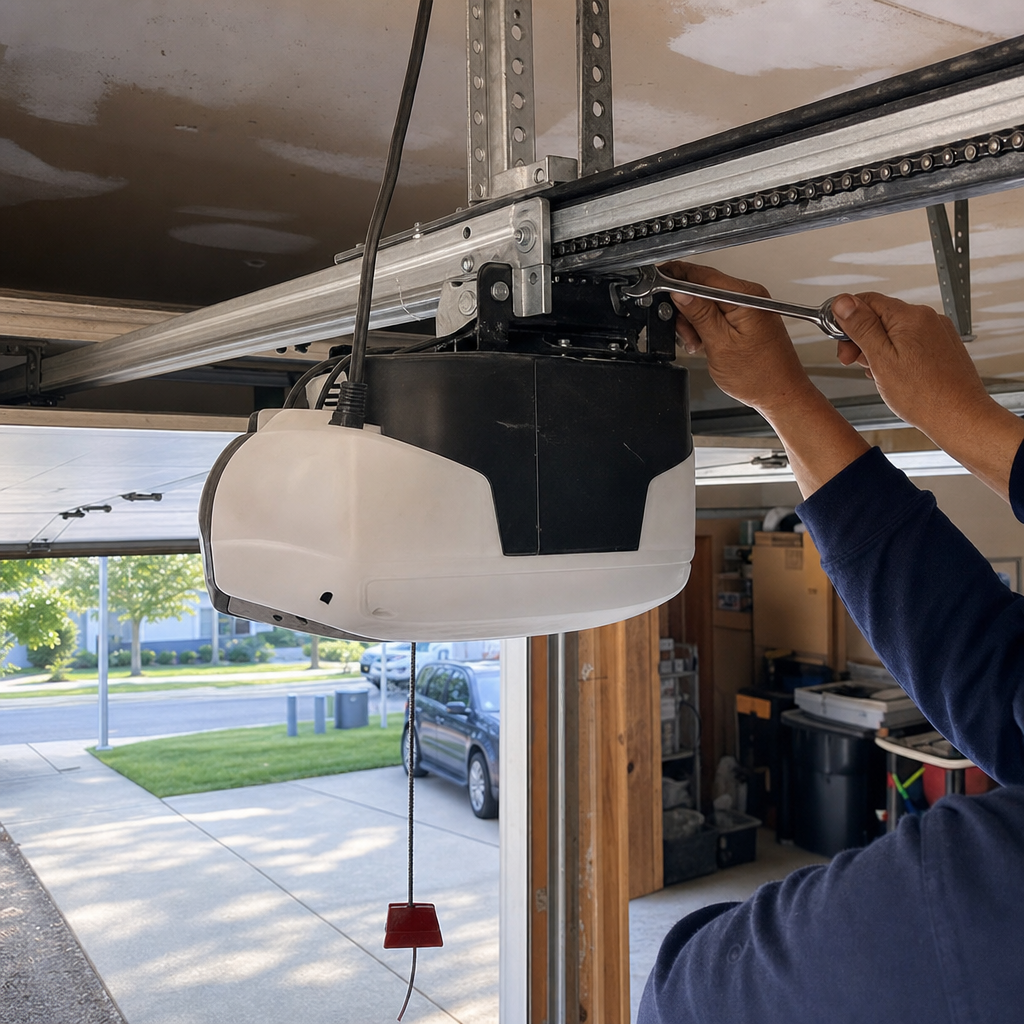
- Full hardware torque check. The vibration of daily operation loosens bolts and screws over time. With the door closed, check all visible fasteners on hinges, track brackets, and the opener mounting. Do NOT over-tighten — stripped lag bolts in header mounting are a common DIY error we repair in April.
- Lubrication refresh. Apply high-quality garage door lubricant to hinges, rollers (on the bearings, not the tread), and spring coils. Wipe excess — over-lubrication attracts pollen and dust. In Atlanta, we prefer dry-film or synthetic lubricants for spring and summer application because they resist pollen adhesion better than petroleum-based products.
- Cable inspection. Look for fraying, rust spots, or cable unwind from the drum. Cables work in tension with springs; if a spring is failing, the cable shows abnormal wear patterns. Never touch cables under tension — they can cause severe laceration if they snap.
- Opener force and limit settings. After hardware refresh, the opener may need recalibration. Modern Genie and LiftMaster units have electronic force sensing, but these drift over time. If your door reverses unnecessarily or doesn’t fully seal at the bottom, settings need professional adjustment.
Why spring timing matters for Atlanta: Our pollen season begins in earnest by late March. Completing maintenance in early March means fresh lubricant and clean tracks before the yellow coating arrives. Wait until April, and you’re working against pollen accumulation.
Neighborhood note: In Atlanta’s historic districts — Grant Park, Cabbagetown, Old Fourth Ward — many garages are 80–100 years old with original or early-replacement framing. The header above the door (the structural member that carries spring tension) may be compromised by age or previous termite damage. Spring is when we inspect these carefully, before summer heat adds load to potentially weakened structure. If your garage is pre-1960, have a professional assess header condition during spring maintenance.
The 30-Minute Seasonal Walkthrough You Can Actually Stick To
The reason most maintenance plans fail: they’re too ambitious. Here’s a realistic 30-minute rhythm that fits into existing home maintenance — tied to seasons you already notice.
Schedule anchor: Link each check to an existing seasonal task. June check when you service the lawn mower. September check when you schedule HVAC filter replacement. December check when you hang holiday lights. March check when you file taxes (unpleasant, memorable, annual).
The walkthrough structure:
- Visual sweep (5 minutes): Stand inside with the door closed. Scan springs, cables, rollers, hinges, and opener rail for anything visibly different from last season — new rust, new gaps, new noise sources.
- Operational listen (5 minutes): Open and close the door twice. Note any new grinding, squealing, shuddering, or hesitation. A change in sound is your earliest warning.
- Balance and safety test (10 minutes): Disconnect opener, test manual lift and balance. Test auto-reverse with 2×4. Test emergency release.
- Track and seal inspection (10 minutes): Clean tracks if needed. Check weather stripping pliability. Look for light leaks.
Documentation: Take one photo each season of the spring, the bottom seal, and the track condition. Compare year-over-year. The camera catches deterioration your eye normalizes.
When to escalate: If any check reveals a change from the previous season, call for professional inspection. Catching a $200 adjustment in June prevents a $600 emergency in October.
We’ve guided hundreds of Atlanta homeowners through this rhythm. The ones who stick to it — typically those who calendar it with another seasonal task — average one professional service call every 3–4 years instead of every 18 months.
Common Mistakes to Avoid
- Using WD-40 on garage door components. WD-40 is a water displacement solvent, not a lubricant. It strips existing grease, evaporates quickly, and leaves metal unprotected. We remove its residue from Atlanta doors monthly.
- Ignoring the door after an opener upgrade. New LiftMaster or Chamberlain openers mask underlying door problems with stronger motors. The door may be unbalanced or binding, but the new opener powers through — until it burns out prematurely. Always service the door mechanism when replacing an opener.
- Pressure-washing tracks and components. Atlanta homeowners love pressure washers, but forced water drives debris into bearings, initiates rust in hinge pins, and strips lubricant from cable drums. Brush and cloth only.
- DIY spring “adjustment” from online videos. The videos make winding bars look manageable. They’re not. We’ve treated injuries from slipped winding bars in Marietta, Roswell, and inside Atlanta proper. The $150–$250 professional spring service is cheaper than an ER visit.
- Waiting for complete failure. The grinding roller becomes the derailed door. The slow-opening door becomes the opener burnout. Atlanta’s climate accelerates these progressions — a 6-month warning elsewhere becomes a 6-week warning here.
- Neglecting fall maintenance because “pollen season is over.” Atlanta’s fall pollen is less visible than spring’s yellow haze but equally damaging to track systems. September maintenance prevents October emergencies.
When to Call a Professional
Some situations demand trained intervention — not because homeowners are incapable, but because the risk-reward calculation favors expertise. Call a professional when you observe: visible gaps in torsion springs; frayed or unwinding cables; door binding or derailment; opener motor straining or thermal shutdown; or any safety system failure (auto-reverse, photo-eye, emergency release).
Garage Door Repair in Atlanta requires understanding local climate stress patterns, not just mechanical skill. Larry Peterson — Owner and Lead Technician at Sequoia Garage Door Repair Georgia — handles your job personally, bringing 17 years of hands-on experience with the brands already in your garage. We stock and service LiftMaster, Chamberlain, Genie, and Clopay systems — no learning curve, no guesswork. When your garage door won’t move, we show up — that’s what emergency service means.
Sequoia Garage Door Repair Georgia offers free estimates in Atlanta — call (844) 950-3304.
Frequently Asked Questions
Professional seasonal tune-ups in Atlanta typically range from $150–$250 for a standard residential door, depending on whether spring tension adjustment, roller replacement, or opener recalibration is needed. Emergency repairs after neglected maintenance average $400–$800. Call (844) 950-3304 for an exact quote — estimates are free.
Twice yearly — in March before pollen season and in September before fall debris accumulation. Atlanta’s humidity and temperature swings degrade lubricant faster than drier climates. Use synthetic or dry-film lubricant formulated for garage doors, not general-purpose sprays.
Yes — sustained temperatures above 90°F accelerate metal fatigue and reduce spring cycle life by 20–30%. Garages with west-facing exposure or dark-colored doors experience the most thermal loading. Visual inspection for coil gaps in June catches early degradation.
Absolutely. Atlanta’s fall ragweed and mold spore season creates fine debris that mixes with lubricant to form track-clogging paste. This is particularly severe in tree-canopied neighborhoods like Virginia-Highland and Druid Hills. September track cleaning prevents October roller failures.
Insulation helps if your garage is attached and you want to reduce thermal transfer to living spaces, but it’s not critical for door function. The more important winter investment is quality weather stripping that survives freeze-thaw cycling. Standard vinyl seals become brittle after 2–3 Atlanta winters; upgraded EPDM rubber lasts 5–7 years.
No. Torsion springs store lethal energy. Winding bar slippage causes severe injury annually. Visual inspection and balance testing are appropriate DIY tasks; any spring adjustment requires professional tools and training. This is non-negotiable for safety.
The Bottom Line
Atlanta’s garage doors fail in predictable patterns — summer heat weakens springs, fall pollen clogs tracks, winter freeze-thaw cracks seals, and spring offers your last best chance to intervene. The homeowners who avoid emergencies aren’t luckier; they’re calendar-disciplined. Four 30-minute seasonal checks, tied to tasks you already do, catch problems when they’re $150 adjustments instead of $600 surprises. The cost of prevention is modest. The cost of neglect, in Atlanta’s specific climate, is reliably higher and reliably timed for maximum inconvenience.
Ready to put your garage door on a proper seasonal schedule? Sequoia Garage Door Repair Georgia home is here to help. Whether you need a spring tune-up before summer hits, track cleaning after pollen season, or a full system assessment, Larry Peterson — Owner and Lead Technician — handles your job personally. With 17 years of hands-on experience and expertise across 8 major brands including Garage Door Opener in Atlanta systems from LiftMaster, Chamberlain, and Genie, we bring seasoned, consistent skill to every call. Garage Door Installation in Atlanta or repair, we’re ready when you are. Call (844) 950-3304 for your free estimate.
Written by Larry Peterson, Owner & Lead Technician at Sequoia Garage Door Repair Georgia, serving Atlanta since 2009.