
Last updated July 11, 2026
How to Hire a Garage Door Contractor in Atlanta: A Step-by-Step Guide
Atlanta has dozens of garage door companies listed on Google. At least half of them are franchise call centers that will dispatch a subcontractor you’ve never met, who reports to a regional manager you’ll never speak to. Here’s how to screen them out before you book. In 17 years of working on Atlanta homes — from Buckhead estates to Decatur bungalows to Sandy Springs split-levels — we’ve seen the same pattern repeat: homeowners choose based on who answers fastest, then discover the “technician” was hired last week and can’t explain why their Raynor opener keeps throwing error codes. This guide shows you the exact questions to ask, the credentials to verify, and the quote structure that separates accountable pros from volume shops.
Quick Answer
To hire a garage door contractor in Atlanta, verify Georgia contractor licensing, confirm whether the person quoting is the same person who will do the work, request a line-item written estimate, and check reviews specifically for bait-and-switch complaints. Avoid any company that won’t commit to a technician’s name, charges diagnostic fees on top of “free” estimates, or pressures you on the first visit.
Table of Contents
- Step 1: Verify Georgia Licensing — What’s Required and What’s Not
- Step 2: Ask These 5 Questions on the First Call
- Step 3: Decode the Business Model — Owner-Operator vs. Franchise Dispatch
- Step 4: Read Reviews Like a Pro — Red Flags in Atlanta Listings
- Step 5: Understand What a Fair Quote Looks Like
- Step 6: Compare Warranties, Parts, and Brand Expertise
- Common Mistakes to Avoid
- When to Call a Professional
- Frequently Asked Questions
- The Bottom Line
Step 1: Verify Georgia Licensing — What’s Required and What’s Not
Georgia requires a Residential Basic Contractor license for any garage door work exceeding $2,500, issued by the Georgia Secretary of State’s Professional Licensing Boards Division. Here’s what that actually means for your hiring decision.
What Georgia licensing covers: The license proves the contractor passed a trade exam, carries required insurance, and has a background check on file. It does NOT guarantee garage door-specific expertise. A licensed general contractor can legally install your door while never having touched a torsion spring in their life.
What it doesn’t cover: Georgia has no separate “garage door specialist” license. Anyone with a Residential Basic license can legally perform the work. This is why your verification step matters — the license is a floor, not a ceiling.
How to verify: Ask for the license number and check it at sos.ga.gov. Confirm the name matches the person you’re speaking with. In our experience, dispatch centers often operate under a principal’s license while sending unlicensed subcontractors — legal, but not what most homeowners expect.
Atlanta-specific context: Fulton and DeKalb counties have additional permitting requirements for new garage door installations, particularly in historic districts like Inman Park and Virginia-Highland. An Atlanta contractor who’s done this before will know whether your job triggers a permit — a national call center reading from a script won’t.
Step 2: Ask These 5 Questions on the First Call
These five questions separate accountable technicians from dispatch operations. Write them down before you call.
- “Will the person who gives the estimate also do the work?” If the answer is no, you’re dealing with a dispatch model. The estimator’s expertise is irrelevant if a different technician shows up with different tools and different judgment.
- “How long have you worked on garage doors specifically?” General handyman experience doesn’t translate. Torsion spring systems, safety sensor alignment, and opener logic board diagnostics require dedicated repetition. Larry Peterson — Owner and Lead Technician — handles your job personally, bringing 17 years of hands-on experience with the brands already in your garage.
- “What brands do you stock parts for?” A technician who carries LiftMaster, Chamberlain, and Genie components can often finish same-day. One who has to “check with the warehouse” is guessing. We stock and service major systems — no learning curve, no guesswork.
- “What’s your diagnostic fee if I decline the repair?” “Free estimates” often hide this charge. Get clarity upfront. At Sequoia Garage Door Repair Georgia home, we believe transparency starts with the first conversation.
- “Can you give me a ballpark for [specific problem]?” Experienced technicians can range common issues. Vague answers suggest either inexperience or a deliberate strategy to get boots on the ground before disclosing pricing.
In Atlanta’s climate, spring corrosion from humidity and pollen buildup on photo-eye sensors are common issues a local technician will recognize immediately. Someone reading from a national troubleshooting guide won’t.
Step 3: Decode the Business Model — Owner-Operator vs. Franchise Dispatch
Atlanta’s garage door market has two distinct structures, and the difference affects everything from pricing consistency to who stands behind the work.
Franchise dispatch model: A national brand sells territories to local operators who hire technicians as 1099 subcontractors. The “company” you call is often a call center in another state. They optimize for volume — more calls, faster turns, lower technician pay. The result: high turnover, inconsistent quality, and a structural incentive to upsell since subcontractors earn commission on parts.
Owner-operator model: The person who answers your call is the person who shows up with the tools. Larry Peterson built Sequoia Garage Door Repair Georgia on this structure specifically because he’d seen the alternative from the inside. When your garage door won’t move, we show up — that’s what emergency service means. There’s no regional manager to escalate to; the owner is on your driveway, accountable by name.
How to tell which you’re dealing with:
- Search the company name + “franchise” — many are proud of it
- Check if the website shows a real person’s name and face, or only stock photos
- Ask directly: “Are you the owner?” If they deflect, there’s a reason
- Look at review patterns — owner-operators accumulate detailed, name-specific praise over years; dispatch models get generic “technician was nice” comments
Our 296 verified reviews averaging 4.8 stars reflect a consistent, long-term track record rather than a handful of cherry-picked testimonials. That’s the difference repetition and accountability make.
Step 4: Read Reviews Like a Pro — Red Flags in Atlanta Listings
Don’t just scan star averages. Here’s how to extract real signal from Atlanta garage door reviews.
Red flag patterns to search for:
- “Came for $79 tune-up, left with $900 quote” — Classic bait-and-switch. The low initial price exists only to create a visit, then the upsell begins.
- “Different guy than last time” — Confirms dispatch model. No continuity, no accumulated knowledge of your system.
- “Couldn’t fix it, still charged $150” — Diagnostic fee hidden in “free estimate” language.
- “Pushed new door when I only needed springs” — Commission-driven selling, not problem-solving.
- Multiple reviews mentioning “corporate” or “dispatch” — The customer accidentally revealed the business structure the company obscures.
Green flags that signal accountability:
- Reviews naming the same technician across multiple years
- Mentions of specific neighborhoods (Virginia-Highland, Kirkwood, Brookhaven) — shows genuine local presence
- Detailed descriptions of what was fixed and why
- Responses from the owner to negative reviews, not a generic “we’re sorry” template
Atlanta’s review ecosystem has a specific distortion: many franchise locations buy reviews through follow-up email campaigns offering discounts. Sort by “newest” and look for clustering — 15 five-star reviews in two weeks, then silence. Organic reputation builds steadily over years, not in bursts.
Step 5: Understand What a Fair Quote Looks Like
A legitimate garage door quote in Atlanta should be line-item, specific, and explinable. Here’s the structure to demand.
| Line Item | Typical Atlanta Range | What to Verify |
|---|---|---|
| Torsion spring replacement (pair) | $280–$420 | Spring cycle rating (10,000 vs. 20,000 cycles) |
| Extension spring replacement (pair) | $180–$280 | Safety cable inclusion |
| Garage door opener installation | $380–$650 | Brand/model specified, rail type included |
| Cable replacement (pair) | $150–$220 | Pulley inspection included |
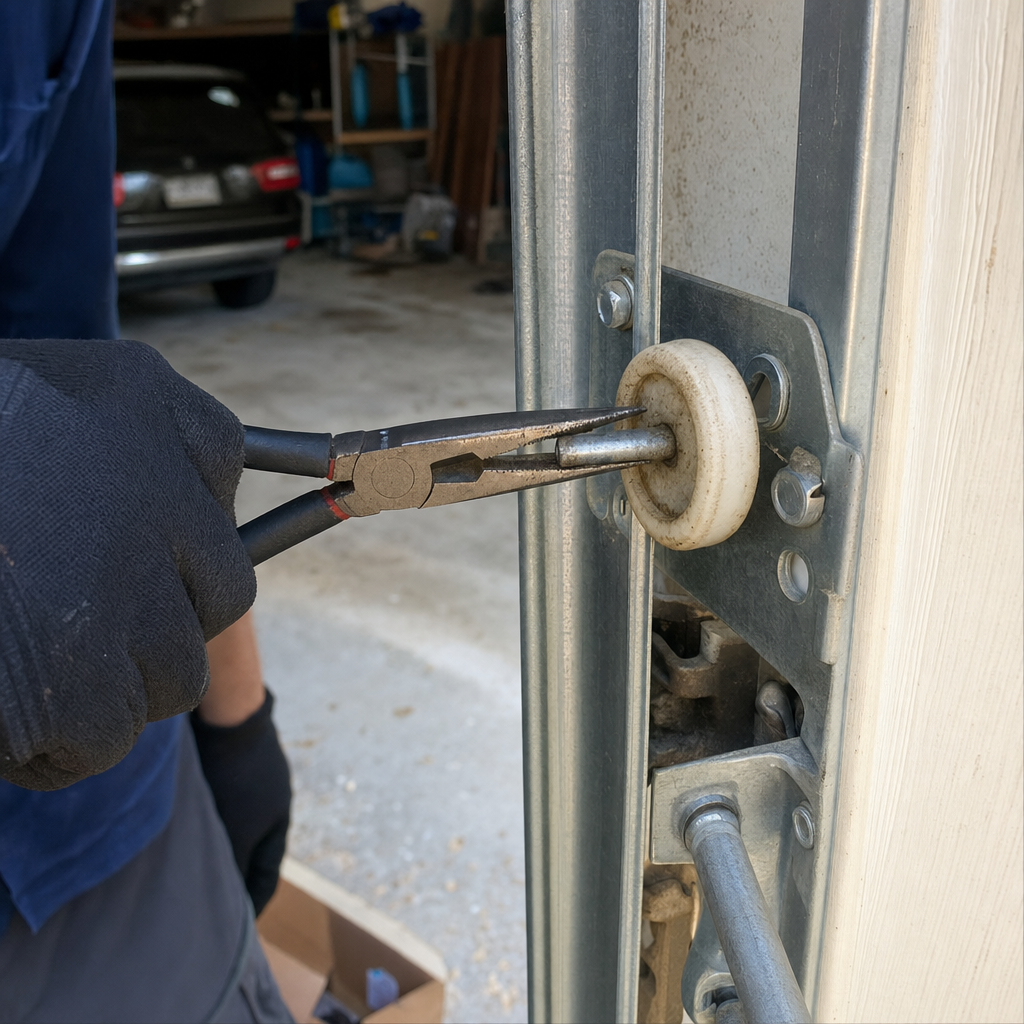
| Roller replacement (full set, 10–12) | $200–$320 | Nylon vs. steel specified |
| Panel replacement (single, standard steel) | $350–$550 | Color match guarantee |
| Full door replacement (installed, 16×7 steel) | $1,200–$2,400 | Insulation R-value, wind load rating |
| Service/diagnostic call | $75–$125 | Applied to repair if authorized |
Warning signs in quoting:
- Lump-sum pricing with no itemization — you can’t compare or verify
- Pressure to decide “today only” for a discount — manufactured urgency
- Verbal quotes only — no paper trail when something goes wrong
- “We need to open it up to know” for obvious issues like broken springs — experienced technicians diagnose visible failures before arrival
Atlanta’s pricing has geographic variance: intown neighborhoods with tighter access (narrow driveways in Grant Park, steep grades in Morningside) may carry modest trip adjustments. A local contractor knows this; a dispatch center applies uniform pricing then surprises you with add-ons.
Step 6: Compare Warranties, Parts, and Brand Expertise
The final screening layer: what happens after the work is done, and whether the technician actually knows your equipment.
Parts warranty vs. labor warranty: These are separate. A spring might carry a 3-year parts warranty, but if the labor warranty is 30 days, you’re paying again when the installation fault shows up in month two. Ask for both, in writing.
Brand expertise matters: Garage door systems are not interchangeable. A Genie screw-drive opener has different failure modes than a LiftMaster belt-drive. Chamberlain’s MyQ integration has specific compatibility requirements. A technician who says “they’re all basically the same” is telling you about their limitations.
Larry Peterson is factory-familiar with 8 major brands — LiftMaster, Chamberlain, Genie, Clopay, Amarr, Wayne Dalton, Craftsman, and Raynor — meaning no guesswork regardless of what’s in your customer’s garage. This isn’t credential-stacking; it’s the difference between diagnosing a Raynor operator’s logic board in 10 minutes versus ordering the wrong part twice.
Atlanta-specific brand prevalence: In our market, LiftMaster and Chamberlain dominate newer construction, while older intown homes often have original Raynor or Craftsman systems. A contractor who hasn’t worked on Raynor’s older torsion hardware will struggle with the spring anchor brackets common in 1980s Atlanta builds.
For new Garage Door Installation in Atlanta, verify the proposed door’s wind load rating. Georgia amended wind provisions in recent code cycles, and coastal-influenced zones in south metro counties have specific requirements a local installer will know.
Common Mistakes to Avoid
- Hiring based on lowest quote alone. A $180 spring replacement using 5,000-cycle springs costs more over time than a $320 job with 20,000-cycle hardware. Atlanta’s humidity accelerates corrosion on cheap springs.
- Assuming “licensed and insured” means garage door expertise. Georgia’s Residential Basic license is broad. Ask specifically: “How many garage door springs have you replaced this month?”
- Ignoring response pattern in reviews. A company with 50 reviews but 15 complaints about no-shows has an operational problem, not a few bad customers. In Atlanta traffic, realistic arrival windows matter.
- Accepting phone quotes without photos. Send pictures of your door, opener model plate, and any visible damage. A competent contractor can narrow the estimate range before arriving.
- Not asking about opener compatibility. If you’re replacing an opener, confirm the new unit works with your existing door’s horsepower requirements and safety sensor configuration. We’ve rescued multiple Atlanta homeowners who bought “universal” openers that weren’t.
- Waiting until complete failure. A door that groans, shudders, or reverses intermittently is telling you something. Emergency calls cost more, and you’re stuck with whoever answers at 8 PM.
- Neglecting to check for Garage Door Opener in Atlanta expertise separately. Opener diagnostics require different skills than mechanical door repair. Verify your contractor handles both, or you’ll be calling twice.
When to Call a Professional
Some situations demand immediate professional attention — and some are genuinely dangerous to attempt yourself.
Call now: A door stuck open, a snapped cable, or a spring that’s visibly separated. These create security exposure and physical hazard. Torsion springs store massive energy; release without proper winding bars causes serious injury. We’ve seen homeowners in Buckhead and East Atlanta attempt spring replacement with screwdrivers and YouTube confidence — the ER visits aren’t worth it.
Call soon: Intermittent reversing, uneven door movement, or opener strain noises. These degrade into expensive failures if ignored. In Atlanta’s pollen season, photo-eye misalignment from debris is common and easily fixed — if caught early.
Schedule proactively: Any door over 10 years old without recent service. Preventive maintenance costs fractionally compared to emergency replacement.
Sequoia Garage Door Repair Georgia offers free estimates in Atlanta — call (844) 950-3304. Larry Peterson handles your job personally, and 17 years of hands-on experience means we spot developing issues before they strand your car in the garage.
Frequently Asked Questions
Most common repairs in Atlanta range from $180 for extension spring replacement to $420 for torsion spring pairs, with opener repairs typically between $150–$300 depending on parts. Full door replacement starts around $1,200 for standard 16×7 steel. Call (844) 950-3304 for an exact quote — estimates are free.
Repair is usually more economical if the door is under 15 years old, the damage is isolated to one panel or component, and the opener still functions reliably. Replacement makes sense when multiple panels are damaged, the door lacks modern safety features, or repair costs exceed 50% of replacement. We evaluate this honestly on every call — no upsell pressure.
Emergency garage door service is available for urgent, time-sensitive situations — doors stuck open, broken springs with vehicles trapped inside, or security-compromised situations. Response time depends on current call volume and your location within the metro area. Call (844) 950-3304 and we’ll give you a realistic arrival window.
Ask whether the person quoting will also do the work, how many years they’ve specialized in garage doors specifically, what brands they stock parts for, whether there’s a diagnostic fee if you decline repair, and whether they can ballpark your specific issue. Vague answers to any of these suggest a dispatch model, not direct expertise.
A Residential Basic Contractor license is required for work exceeding $2,500, but Georgia has no garage door-specific license. This means any licensed contractor can legally perform the work regardless of actual experience. Verify the license at sos.ga.gov, then ask targeted questions about their specific garage door history.
The franchise dispatch model incentivizes upselling — subcontractors often earn commission on parts, and low initial quotes are designed to get technicians inside your home. Read reviews specifically for “came for X, quoted Y” patterns. Owner-operated businesses with transparent, line-item pricing don’t generate these complaints at the same rate.
The Bottom Line
Hiring a garage door contractor in Atlanta comes down to three verifiable facts: Georgia licensing you can check, a business structure that puts accountability on the job site, and quotes transparent enough to compare. The franchise dispatch model dominates search results because it optimizes for marketing spend, not technician retention. Owner-operated alternatives exist — they’re harder to find because they spend less on ads and more on doing the work right. Ask the five questions, read reviews for patterns not stars, and demand line-item pricing. The 30 minutes you spend screening saves hundreds in surprise charges and years of frustration from repeat failures.
For Garage Door Repair in Atlanta done by the person who answers your call, contact Sequoia Garage Door Repair Georgia at (844) 950-3304. Larry Peterson — Owner and Lead Technician — handles your job personally, bringing 17 years of hands-on experience with the brands already in your garage. Free estimates, transparent pricing, and nearly 300 five-star reviews from real homeowners.
Written by Larry Peterson, Owner & Lead Technician at Sequoia Garage Door Repair Georgia, serving Atlanta since 2009.